Leaving No One Behind: The Role of Social Protection for Inclusive and Sustainable Growth in Middle-Income Countries
More from this series


The working paper analyzes the diverse financing options and fiscal strategies necessary to expand social protection in Asia and the Pacific, underscoring the critical importance of social protection amidst climate challenges. It examines the gaps in current social protection spending, where the region's average expenditure of 8.2% of GDP falls significantly below the global benchmark. The paper presents an array of financing mechanisms, including social security contributions, innovative tax reforms, reallocation of fossil fuel subsidies, and green and social bonds, alongside newer frameworks like multilateral climate funds and the newly established Loss and Damage Fund. It further highlights the synergy between social and climate resilience, advocating for robust social protection frameworks that can buffer against climate-induced displacement, support mitigation and adaptation efforts, and address emerging health risks. The paper is organized into sections on core funding sources, innovative and targeted fiscal policies and green, climate and complementary funding sources, with a comprehensive evaluation of each approach. By promoting cross-sectoral cooperation and exploring synergies between social protection and climate action, the paper argues that nations can create sustainable social protection models and build resilience against future climate and other type of shocks.
Social protection schemes provide cash or in-kind support for people facing life cycle contingencies, such as having children, getting sick, acquiring a disability, losing a job or growing older. Social protection is also an important tool to protect people from covariate shocks, such as natural disasters, economic crises and pandemics. Lack of social protection exposes everyone to financial uncertainty and contributes to increasing within- and across-country inequalities.
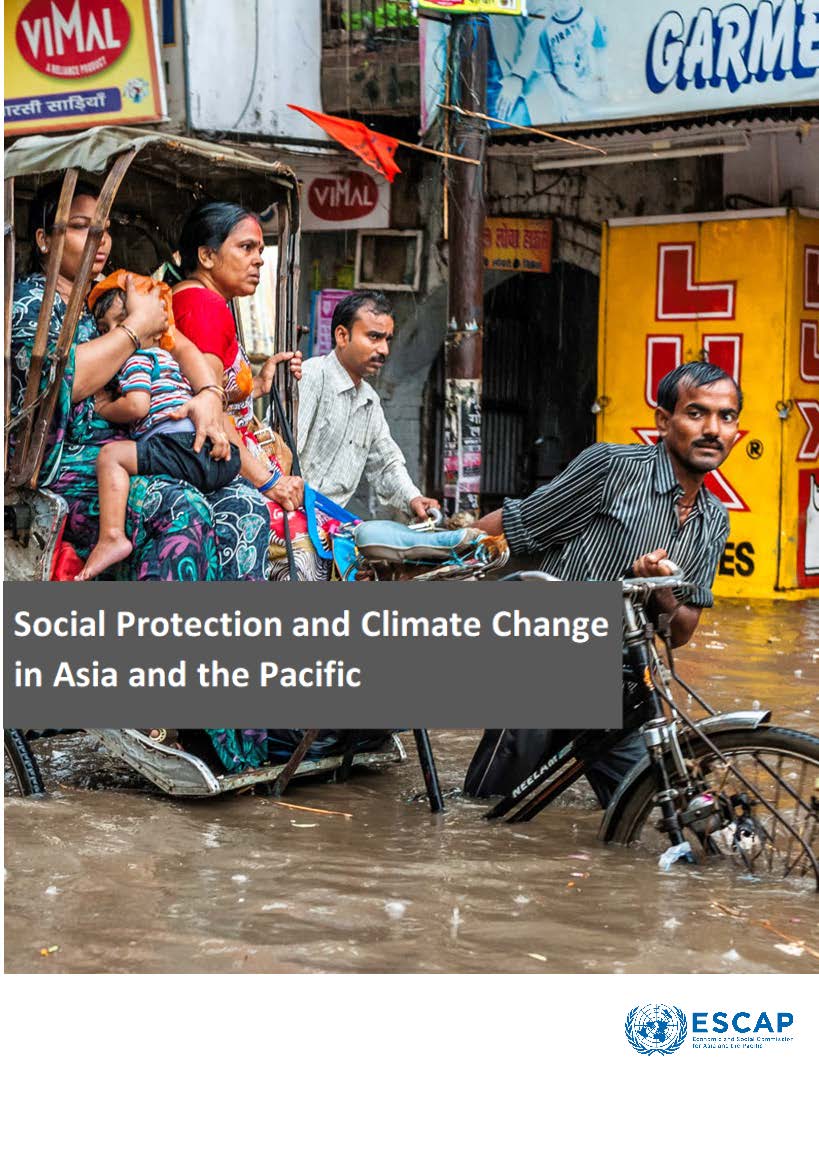
Social protection plays an important role in supporting climate change adaptation and mitigation efforts, particularly in the Asia Pacific region where many remain without adequate coverage. Sustainably expanding social protection is essential, with a focus on vulnerable groups, including informal workers, migrants, people with disabilities, and marginalized communities. To be effective, social protection systems must be rights-based, comprehensive, provide adequate benefits and uphold principles like universality and solidarity. Benefits will also have to take into account the heightened risks from climate change. Governments should explore synergies with disaster risk finance and Paris aligned investments like green bonds and climate funds. Climate-sensitive design, fiscal repurposing, and inclusion in national climate strategies are vital steps in crafting comprehensive, equitable social protection systems that address climate vulnerabilities and promote sustainable development. Gender-specific challenges must also be addressed to ensure effective climate adaptation and mitigation.
This is the tenth in a series of primers developed to support policymakers and practitioners in Asia and the Pacific in their efforts to strengthen social protection. The primer highlights the role of child benefits to support families and the implications of different design features that impact on this.
The first primer in this series explores why social protection is needed; the second explains how to design inclusive and robust social protection systems and focuses on tax-financed income security; the third focuses on its effective implementation; the fourth discusses options for financing; the fifth highlights key concepts and schemes required for disability-inclusive social protection; the sixth illustrates how the design of social protection systems can either exacerbate or mitigate the disadvantage women; the seventh highlights key design elements in developing an inclusive and comprehensive old age pension system; the eighth outlines key strategies to ensure the right to maternity leave and maternity cash benefits; and the ninth clarifies understanding around universality in social protection, what it entails and how it can be operationalised.

This is the ninth in a series of primers developed to support policymakers and practitioners in Asia and the Pacific in their efforts to strengthen social protection. The primer clarifies understanding around universality in social protection, what it entails and how it can be operationalised. The first primer in this series explores why social protection is needed; the second explains how to design inclusive and robust social protection systems and focuses on tax-financed income security; the third focuses on its effective implementation; the fourth discusses options for financing; the fifth highlights key concepts and schemes required for disability-inclusive social protection; the sixth illustrates how the design of social protection systems can either exacerbate or mitigate the disadvantage women; the seventh highlights key design elements in developing an inclusive and comprehensive old age pension system; and the eighth outlines key strategies to ensure the right to maternity leave and maternity cash benefits.
This is the eighth in a series of primers developed to support policymakers and practitioners in Asia and the Pacific in their efforts to strengthen social protection. The primer presents key design features to ensure the right to maternity leave and maternity cash benefits. It also addresses the need for additional care leave schemes and benefits.
The first primer in this series explores why social protection is needed; the second explains how to design inclusive and robust social protection systems and focuses on tax-financed income security; the third focuses on its effective implementation; the fourth discusses options for financing; the fifth highlights key concepts and schemes required for disability-inclusive social protection; the sixth illustrates how the design of social protection systems can either exacerbate or mitigate the disadvantage women; and the seventh highlights key design elements in developing an inclusive and comprehensive old age pension system.
Asia and the Pacific’s success in achieving the United Nations 2030 Agenda for Sustainable Development depends on a healthy, protected and productive workforce. People of working age make up two thirds of the region’s population and more than half of the global labour force. We depend on them to power the economic growth, competitiveness and sustainable development needed to accelerate the region’s progress towards all 17 Sustainable Development Goals. Our workforce generates the tax revenues needed to pay for essential public goods and services and ensures the well-being of dependent family members. Yet the working-age population of Asia and the Pacific is under pressure, denied the decent work opportunities it needs to fulfil its potential.
 SPOT
SPOT Simulate
 Learn
Learn Explore
 SP2LNOB
 CRISP
CRISP