Training package on Social Protection in the Maldives: Basic concepts and design features

This manual is designed as a practical and adaptable resource for conducting social protection training programs that aims to build understanding of key principles and strategies for delivering inclusive and comprehensive social protection systems. It provides guidance on using the training materials of structured content, training methods which reflect adult learning principles. It aims to support capacity building and knowledge management, thereby promoting a proactive social protection mindset and enhancing capacity to implement more inclusive and comprehensive social protection systems. Full session outlines can be made available by contacting the Social Development Division, ESCAP at escap-sdd@un.org

Financing social protection : core financing options and the need to increase synergies with green, climate, humanitarian and alternative funding frameworks for a more climate resilient future

The working paper analyzes the diverse financing options and fiscal strategies necessary to expand social protection in Asia and the Pacific, underscoring the critical importance of social protection amidst climate challenges. It examines the gaps in current social protection spending, where the region's average expenditure of 8.2% of GDP falls significantly below the global benchmark. The paper presents an array of financing mechanisms, including social security contributions, innovative tax reforms, reallocation of fossil fuel subsidies, and green and social bonds, alongside newer frameworks like multilateral climate funds and the newly established Loss and Damage Fund. It further highlights the synergy between social and climate resilience, advocating for robust social protection frameworks that can buffer against climate-induced displacement, support mitigation and adaptation efforts, and address emerging health risks. The paper is organized into sections on core funding sources, innovative and targeted fiscal policies and green, climate and complementary funding sources, with a comprehensive evaluation of each approach. By promoting cross-sectoral cooperation and exploring synergies between social protection and climate action, the paper argues that nations can create sustainable social protection models and build resilience against future climate and other type of shocks.

Stepping stones towards social protection and climate resilience in the Maldives

This report highlights the critical yet underexplored intersection between social protection policies and climate change policies and events in the Maldives. Despite their potential, social protection policies are rarely integrated into climate policies and vice versa. Vulnerable populations, particularly those in climate change hotspots, face escalating risks from sudden and slow-onset climate events, including heatwaves, floods, cyclones, storm surges and tsunamis in the Maldives. These hazards exacerbate inequalities, impacting health, food security, income, and displacement. The report emphasizes that without adequate social protection coverage, populations will struggle to build resilience and cope with these intensifying challenges. Effective integration of social protection into climate policies is essential to address climate justice, promote inclusive growth and support just transitions.

The report identifies the necessity of social protection measures such as unemployment insurance, universal health coverage, and targeted cash transfers to support populations affected by climate hazards. It advocates for extending coverage to ensure social protection floor for all, redirecting investments to encourage green technologies that enhance climate resilience of vulnerable populations, and reviewing the role of social protection in emergency cash transfer mechanisms. Synergies between climate financing and social protection systems are crucial to ensure efficient resource utilization and resilience-building. Ultimately, the report calls for coordinated, evidence-based approaches to integrate social protection and climate policies, highlighting the importance of capacity-building, financing, community engagement, and knowledge-sharing to achieve sustainable and equitable outcomes.

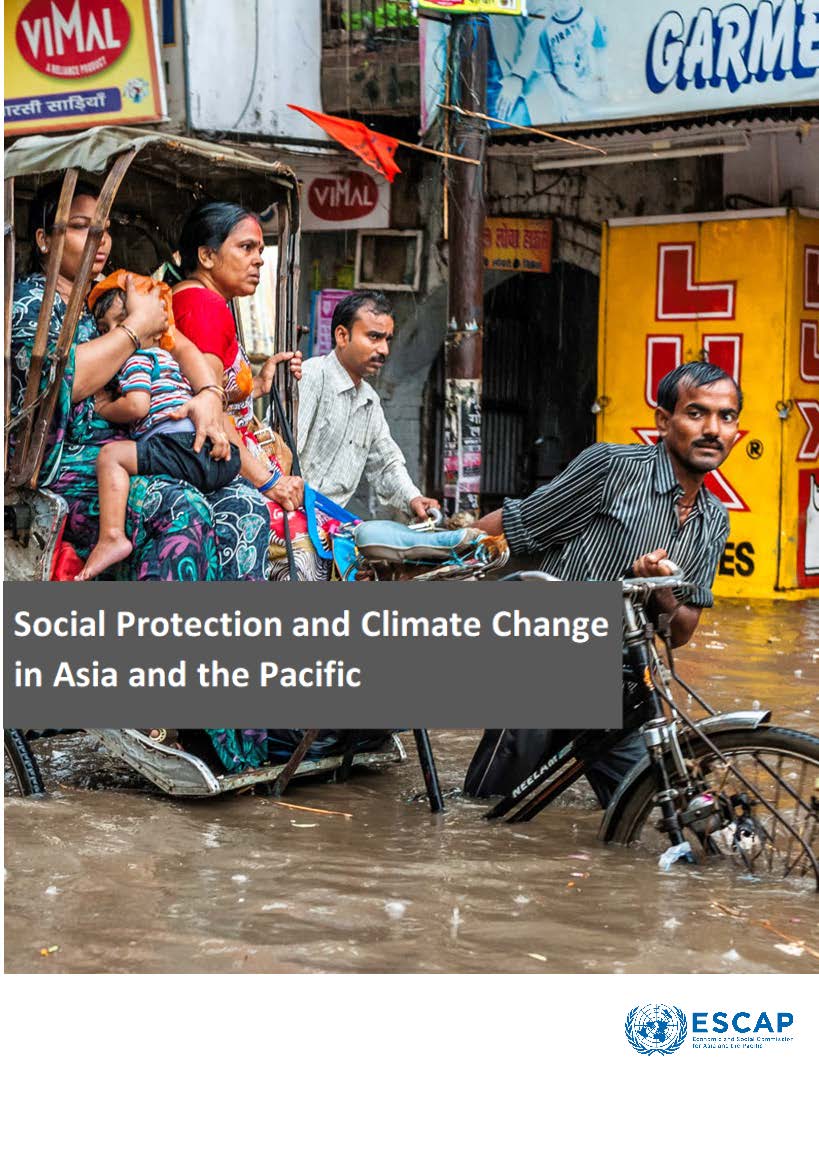
Social protection and climate change in Asia and the Pacific

Social protection plays an important role in supporting climate change adaptation and mitigation efforts, particularly in the Asia Pacific region where many remain without adequate coverage. Sustainably expanding social protection is essential, with a focus on vulnerable groups, including informal workers, migrants, people with disabilities, and marginalized communities. To be effective, social protection systems must be rights-based, comprehensive, provide adequate benefits and uphold principles like universality and solidarity. Benefits will also have to take into account the heightened risks from climate change. Governments should explore synergies with disaster risk finance and Paris aligned investments like green bonds and climate funds. Climate-sensitive design, fiscal repurposing, and inclusion in national climate strategies are vital steps in crafting comprehensive, equitable social protection systems that address climate vulnerabilities and promote sustainable development. Gender-specific challenges must also be addressed to ensure effective climate adaptation and mitigation.

Public Sector Initiatives for Reducing Inequality: Strengthening the evidence base to Leave No One Behind

To illustrate how the design and implementation of social protection policies can reduce inequality, this report uses two examples from FEALAC Member States in Asia, namely the Child Money  Programme (CMP) in Mongolia and the Old Age Allowance (OAA) in Thailand.

This research report was produced as part of a FEALAC-funded project on “Reducing Inequality in FEALAC Member Countries - Innovative Policy Making that Leaves No One Behind”

Find out more about reducing inequalities in FEALAC countries under “Know your policy” here.

Social protection and the informal economy : what do we know?

This paper takes stock of the literature that examines how the recent expansion of contributory and non-contributory social protection programmes in low- and middle-income countries in Asia and the Pacific, Latin America and Africa has influenced the conditions and incentive mechanisms that underpin work choices in the informal economy. In reviewing the literature, we adopt a systematic review methodology to identify studies, which through experimental, quasi-experimental, or qualitative research designs examine modalities and design features of these policies and how they impact the transition of formal (or informal) workers to the informal (or formal) economy. Overall, we find that the existing evidence base is too limited to draw definitive conclusions about ‘how’ the expansion of social protection systems is impacting the informal economy. While certain policy reforms to contributory social insurance schemes have produced desirable incentives for workers to formalise, other types of non-contributory programmes seem to discourage workers from entering the formal economy. These effects are nonetheless small and among certain populations. The study underscores the need for further research to better understand the conditions that seem to be detrimental for formalization and the mechanisms that underpin these effects; and how policy reforms could mitigate these unintended outcomes while procuring social justice and equity.

The impact of ageing on accessibility, affordability and availability of healthcare services in Asia and the Pacific

The Agenda 2030 for Sustainable Development (United Nations, 2015) is a call for “[a] world with equitable and universal access to… health care and social protection, where physical, mental and social well-being are assured”. While some challenges to the meeting of this goal are difficult to predict, and outwith the scope of modelling, a key potential driver of this is the changing age profile of populations. This paper summarises the likely challenges to the delivery of this goal arising from changes in the age structure of countries in Asia and the Pacific. It then seeks to model the extent to which future healthcare expenditures (HCEs) may vary according to changes in the observable determinants of HCEs. While modelling is subject to significant uncertainty, we provide scenario estimates of future healthcare expenditures according to variation in the age profile of populations, the extent to which future ageing may be healthier, future gross domestic product (GDP), changes in the age profile of per-capita spending, and population preferences for spending on healthcare. Our central estimates are that HCEs as a proportion of GDP are likely to increase from around 5.3% to 9.7% by 2060, rising to 13.2% if assumptions regarding future healthy ageing do not hold. For high income countries in the region, this is likely to peak and level off at around 11% of GDP, while for medium income countries this is projected to reach 9.6% by 2060.

Towards universal social protection

Universality, or the achievement of universal social protection, has been endorsed by the international community and in the region as a key objective of social protection. Solidarity and trust in public systems, including through universal social protection, will underpin the advancement of the 2030 Agenda for Sustainable Development. However, understanding often remains unclear around what universality entails in terms of systems, schemes, combinations of non-contributory and contributory benefits, and eligibility. This paper aims to build understanding of the underlying concepts around universality through first providing a brief trajectory of universality in section 2, before exploring why universal coverage must be achieved in section 3. In section 4 the paper looks at the key lifecycle and labour market contingencies that should be covered while section 5 provides a simplified definition of universality. Section 6 then explores ways forward to achieve universality through a single scheme or multiple schemes. Section 7 provides options to move toward progressively achieving universal coverage within contexts of limited fiscal space. Finally, section 8 discusses the important linkages between universality and the social contract.

Active labour market policies in Asia and the Pacific : a review of the literature

This paper reviews the evidence on the effectiveness of active labour market programmes in low- and middle-income countries with high informality, highlighting examples of interventions that have been implemented in combination with other policies including social protection measures. In reviewing the literature, we adopt a scoping review methodology to identify studies that look at a range of programme outcomes including earnings, employment, formality and productivity. We include studies from 2000 onwards, and after a thorough selection and screening process we end up with 106 papers for the review. Most of these studies find some positive aspect associated with the programme under study, although significant positive aspects are in many cases contingent on a specific target population, or time frame of programme and evaluation. We employ a theory of change conceptual framework to further discuss the channels, mechanisms and assumptions that are seen to underpin programme effectiveness (or the lack of). Success often depends on specific contextual factors and/or the joint implementation of different types of active and/or passive labour market policies, including specific social protection measures or other public policies.